LONDON – The conventional wisdom in Westminster holds that sanctioning Israeli “settlers” is the only way to stop West Bank expansion and hold Israel accountable. Prime Minister Andy Burnham appears ready to test that theory. Reports confirm his government is preparing a broader sanctions package – a trade ban on settlement-linked goods and personal sanctions against leading figures in the settlement movement – going significantly beyond the UK’s June measures, which targeted six firms and one individual over alleged violence in Judea and Samaria.
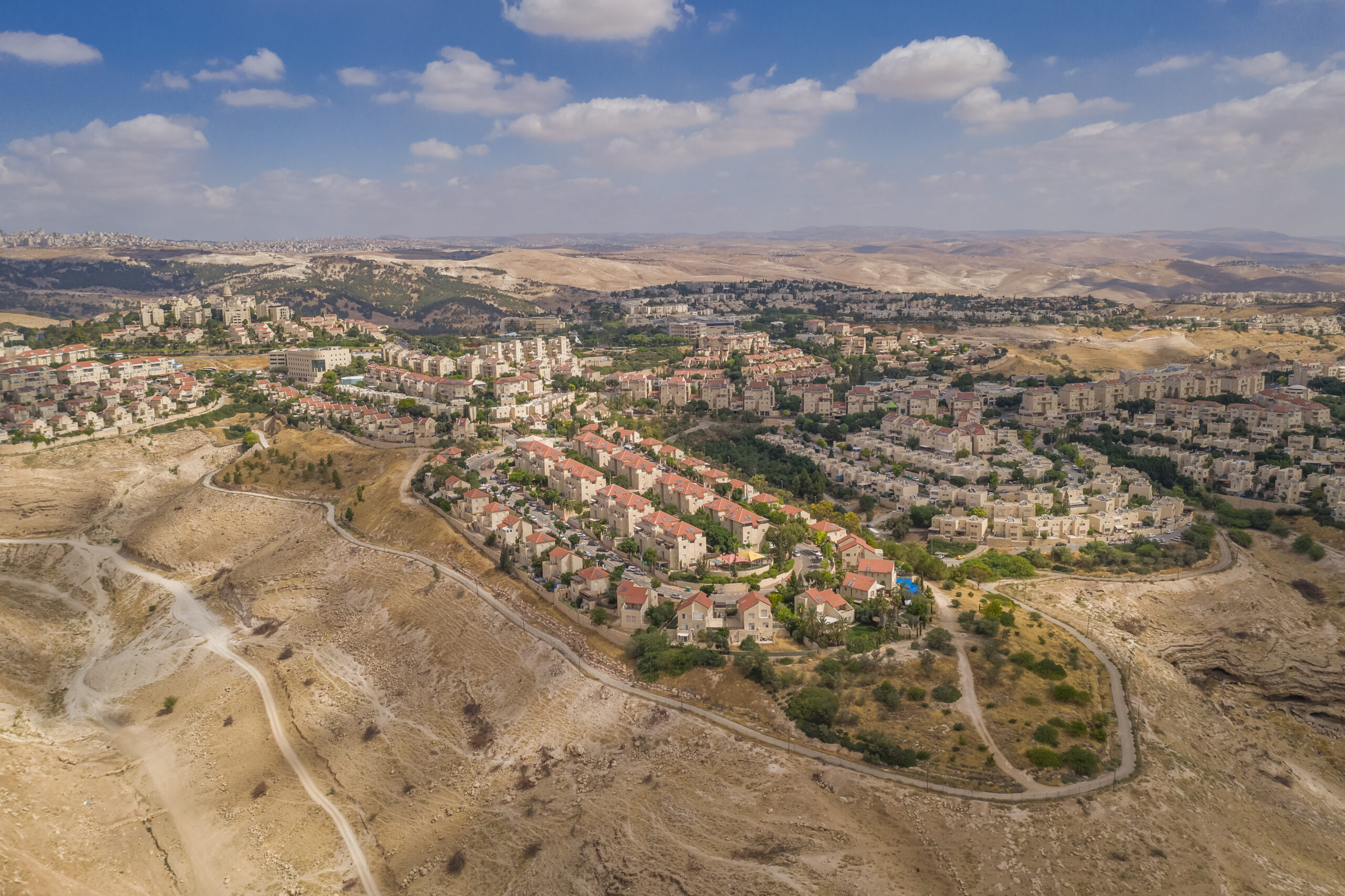
The immediate trigger is construction in the E1 corridor. On August 19, 2026, Israel opened tenders for the stretch of largely uninhabited land connecting Jerusalem to Ma’ale Adumim, a Jewish city of more than 40,000 residents founded in 1977. By August 26, Burnham’s planned response was already in the headlines.
The problem, Israel’s defenders argue, is that Britain is not targeting violent actors. It is targeting ordinary families in a city that even the Clinton peace plan designated to remain part of Israel.
London Prepares the Hammer
Foreign Secretary Ed Miliband had already declared that measures were being prepared to “target sanctions at those who participate in illegal settlement expansion.” British media reported Burnham was considering a trade embargo within weeks – stopping the exchange of both goods and services linked to communities in Judea and Samaria, with possible penalties against settlement leaders and far-right Israeli ministers.
More than 140 Labour MPs have pressed for sharp action. Down the hall, Labour Friends of Israel warned that a settlement-only ban is practically impossible and risks becoming a de facto boycott of all of Israel.
Britain’s own Jewish leadership was not waiting to find out which version wins.
The Chief Rabbi Tries to Be Heard
On August 30, 2026, Chief Rabbi Sir Ephraim Mirvis met personally with Miliband and told him the government’s intended sanctions would be “counter-productive.” The Board of Deputies of British Jews simultaneously issued a public warning that a settlement trade ban could have “harmful consequences for British Jews.”
Mirvis argued the policy would not change Israeli decision-making as London expects. Instead, he warned of a spiral into a broader boycott, damage to UK-Israel relations, harm to tens of thousands of Palestinian workers, and disproportionate impact on British Jews with close family, religious, and educational ties to Israel. Successive peace efforts, he noted, had envisaged E1 remaining under Israeli sovereignty.
“It is therefore difficult to escape the painful conclusion that domestic political considerations are driving foreign policy,” Mirvis said, “the impact of which is negative both for prospects for peace in the Middle East and for the UK Jewish community.”
Burnham pressed ahead anyway.
What E1 Actually Is
The E1 corridor is a 4.6-square-mile stretch of largely uninhabited state land with no Palestinian residents. Ma’ale Adumim sits inside the security barrier on territory the Clinton parameters assigned to Israel – terms the Palestinian Authority accepted in principle. Sanctioning Israelis for living where the PA itself agreed they could, Israel’s defenders say, is not justice. It is theater.
Strategically, Ma’ale Adumim provides depth for Jerusalem’s eastern front. Leaving the city as an isolated enclave connected only by a vulnerable road, as Mount Scopus was between 1948 and 1967, is a security non-starter across Israel’s political spectrum. The Washington Institute and other analysts have long treated E1 linkage as a national consensus issue, not a fringe settler project.
Critics claim E1 would make a Palestinian state impossible. That assumes creating another state west of the Jordan River is a legitimate or desirable goal for Israel to facilitate. After October 7, the central question is not whether Israel can be pressured into enabling a Palestinian state, but whether doing so would create a massive terror hub overlooking Israel’s population centers. E1 strengthens the strategic connection between Jerusalem and Ma’ale Adumim and reinforces Israel’s ability to maintain defensible borders and protect its capital.
The Falklands Test
Britain’s double standard has not gone unnoticed. When MP Rupert Lowe declared the Falklands “British and will remain so” and said a future British government would defend the territory militarily, Yair Netanyahu responded sharply on X:
“You will go to war for some rocks on the other side of the world from Britain, but then expect Israel to give up Judea and Samaria, which is half of our territory (our whole country is the size of Wales), the ancestral homeland of the Jewish people, a land that cuts right through our capital, and sits 15 km from Tel Aviv? Don’t you think it’s a bit hypocritical?”
Britain insists its own territorial claims must be respected while treating Israel’s sovereignty, history, and security concerns as illegitimate. Israel’s entire country is roughly the size of Wales. Judea and Samaria sit 15 kilometers from Tel Aviv. The disparity in how London treats its claims and Israel’s is difficult to miss.
Sanctions Without an Exit
Britain imposed these measures without stating what would ever trigger their removal. There is no compliance demand for Israel to meet – only punishment for Israelis living in a city of 40,000 that even the Clinton parameters recognized as Israeli. Sanctioning a democratic ally this way, critics argue, is not foreign policy. It is signalling.
When the UK formally designates the community where tens of thousands of Israelis live as subject to trade bans, it creates a chilling effect on British Jewish organizations and businesses with Israeli ties. The Board of Deputies’ warning reflects a concrete fear, not a hypothetical one: that crude, untargeted measures will spill beyond their stated target and land on British Jews at home.
The Same Script From London
Britain’s E1 sanctions are not a one-off. They fit a pattern of anti-Israel rhetoric and policy that keeps coming from London – treating normal Jewish life near Jerusalem as illegitimate, ignoring where peace plans actually drew the lines, and pressing ahead even when the Chief Rabbi and the Board of Deputies say the cost at home will be real.
Sanctioning Israeli families in a city Clinton’s plan recognized as Israeli, on empty land with no Palestinian residents, is the same script in a new form. Without a realistic path to compliance or US backing, these measures will not change Israel’s policy. They will satisfy Labour’s activist base, alienate Britain’s Jews, and tell Israelis once again whose side London is on.
When a government ignores its own Jewish community’s warnings to punish Israelis for living in their own country, the goal is not diplomacy. It is signalling – again.
Sources
https://www.jpost.com/international/article-906843, https://www.jns.org/news/world/domestic-politics-drive-britains-proposed-ban-on-settlement-goods-uk-chief-rabbi-says, https://www.jewishnews.co.uk/burnham-government-set-to-announce-west-bank-settlement-import-ban-within-weeks-of-parliament-sitting-again/, https://www.jewishvirtuallibrary.org/jsource/Society_&_Culture/geo/maale.html, https://www.washingtoninstitute.org/policy-analysis/israels-newly-approved-security-fence-route-geography-and-demography, https://www.i24news.tv/en/news/israel/politics/artc-yair-netanyahu-s-falklands-post-draws-backlash-from-israel-s-british-allies, https://www.jewishnews.co.uk/trade-minister-gives-clearest-indication-yet-burnham-government-will-ban-settlement-trade/