
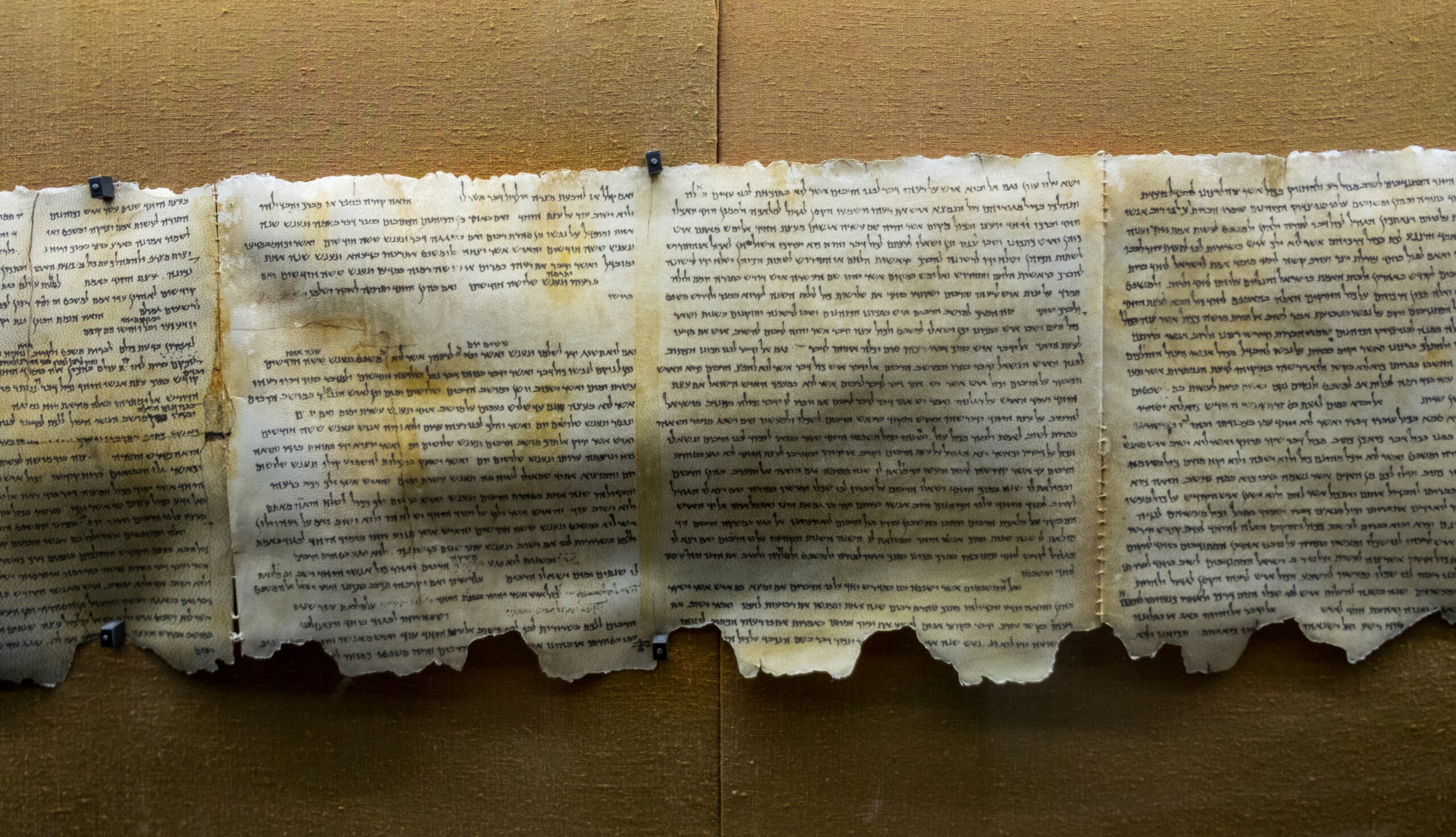
On July 15, a wave of Christian influencers claimed that Abraham, Moses, David, Jesus, and the Torah — including the Ten Commandments — were Christian.
Pastor Dale Partridge, an outspoken critic of Israel, put it this way: “Genesis to Revelation is all about Christ,” citing John 5:46, where Jesus tells his listeners, “If you believed Moses, you would believe Me; for he wrote about Me.”
The comments were a response to Dr. Jordan Peterson, who had simply stated the obvious: the Ten Commandments, the Torah, and Jesus himself were Jewish.
The claim that they were Christian is wrong — historically, chronologically, and theologically.
The Timeline Makes This Impossible
Judaism begins with the Patriarchs, the Exodus, and the giving of the Torah at Sinai — traditionally dated to the 13th–15th century BCE. Christianity begins over a thousand years later, in the 1st century CE, after Jesus’ death.
Jesus and his earliest followers were Jews living within a Jewish world. The New Testament consistently presents Jesus as the fulfillment of Jewish hope — the promised Messiah, the Son of David — not as the founder of an entirely new religion that reaches back in time to claim the Hebrew scriptures as its own.
The Hebrew Bible Is Jewish at Its Core
The Tanakh — Torah (Five Books of Moses), Nevi’im (Prophets), and Ketuvim (Writings) — is the scripture of Judaism. It was written, compiled, and passed down by ancient Israelites and Jews over many centuries.
The Ten Commandments, found in Exodus 20 and Deuteronomy 5, sit at the heart of the Torah given to Moses. They have shaped Jewish law, worship, and ethics for thousands of years, long before Christianity existed.
Christians later embraced this same text as their own scripture, reading it through the lens of the New Testament and interpreting it as pointing toward Jesus. That does not erase the text’s Jewish authorship or original meaning. The Torah is the covenantal instruction for Israel; Christians read it as prophecy fulfilled in Christ. In either case, the text itself remains Jewish in origin.
In fact, the Torah makes up the majority of the Christian Bible by volume, and it wasn’t written by or for Christians. The New Testament may show continuity from a Christian point of view, but that point of view only emerged after the events the Hebrew Bible describes.
John 5:46 Doesn’t Say What They Think It Says
When Jesus tells his listeners, “If you believed Moses, you would believe Me, for he wrote about Me,” he’s a Jewish teacher making an argument to other Jews, from within Jewish tradition, that the Torah and the Prophets point toward the Messiah he claims to be.
That’s an argument about continuity and fulfillment, not a claim that Moses was secretly a proto-Christian, or that the Torah stopped being Jewish. This is standard Christian “fulfillment theology,” echoed elsewhere in the Gospels (Luke 24:27, 44). It does not rewrite history to strip the Hebrew Bible of its Jewish roots.
The New Testament Itself Contradicts the Claim
Several passages directly undercut the idea that the Old Testament is purely Christian or that Jewish identity can simply be written out of it.
Jesus affirms the Law as enduring, not replaced. In the Sermon on the Mount, he says: “Do not think that I have come to abolish the Law or the Prophets; I have not come to abolish them but to fulfill them… until heaven and earth pass away, not an iota, not a dot, will pass from the Law” (Matthew 5:17–19). Jesus treats the Hebrew scriptures as authoritative in their own right, even as he claims to fulfill them.
Paul calls the Jews the guardians of scripture. In Romans 3:1–2, Paul — himself Jewish — writes that the Jews were “entrusted with the oracles of God,” meaning the Hebrew scriptures. In Romans 9:4–5, he lists what belongs to Israel: “the adoption, the glory, the covenants, the giving of the law, the worship, and the promises… the patriarchs, and from them, according to the flesh, comes the Messiah.”
Jesus lived and taught as a Jew, within Jewish practice. Galatians 4:4 says Jesus was “born under the law.” He attended synagogue, celebrated Passover, and referred to “the Law of Moses and the Prophets and the Psalms” (Luke 24:44) — the traditional Jewish canon. None of this makes sense if Moses “was Christian” or if the Law was never distinctly Jewish to begin with.
Jesus calls himself a Jew. Revelation 5:5 identifies him as “the Lion of the tribe of Judah, the Root of David.” And Acts 11:26 notes that “the disciples were called Christians first at Antioch” — two thousand years after Abraham. Nobody was called a Christian before the first century, because Christianity didn’t exist yet.
Paul’s Warning Against Erasing Israel
In Romans 9–11, Paul affirms God’s ongoing faithfulness to Israel. He describes Gentile believers as branches “grafted in” to an existing tree, not as a replacement for the root. “All Israel will be saved,” he writes (11:26), pointing to future restoration, not erasure.
Paul explicitly warns Gentile Christians against arrogance toward the Jewish root that sustains them. Claiming that the Old Testament is “purely Christian,” and that its Jewish identity is a footnote, runs directly against that warning.
The Bottom Line
If pre-Christian Jewish figures and scripture can be retroactively rebranded as Christian just because Christians later saw fulfillment in Jesus, the same logic could justify any later religion claiming ownership of an earlier one. Muslims, in fact, make a nearly identical move — claiming Jesus, Abraham, and Moses were all “Muslims” submitting to God, and that the original message was Islamic before being “corrupted.” Christians rightly reject that as historical revisionism.
The same standard should apply here. Moses and David were Israelites, faithful to the Torah covenant, not adherents of later Christian doctrine. The New Testament tells a story of fulfillment from within the Jewish story. It does not erase that story’s origins.
X, X, X, My Jewish Learning, Aish, John 5:46, Luke 24:27, Luke 24:44, Matthew 5:17–19, Romans 3:1–2, Romans 9:4–5, Galatians 4:4, Revelation 5:5, Acts 11:26, Islam for Christians, Romans 11:17–26