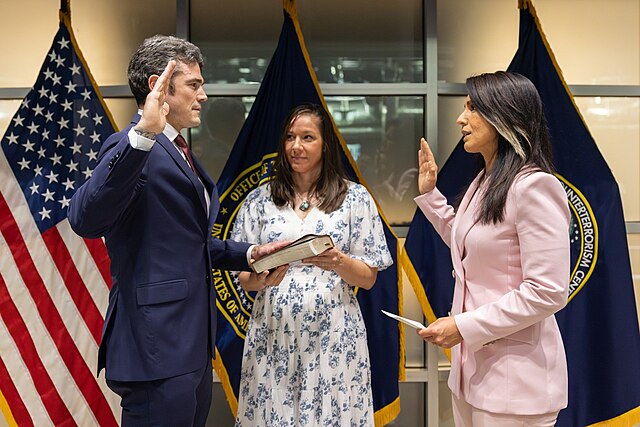
On March 17, 2026, Joe Kent resigned as Director of the National Counterterrorism Center, announcing that he could not “in good conscience support the ongoing war in Iran.” Iran, he claimed, posed no imminent threat, and the United States had been drawn into war by pressure from Israel and its American supporters.
The Implausible “Deception”
It’s a dramatic claim. It asks you to believe that a country smaller than New Jersey somehow managed to deceive not just one official, but the entire U.S. national security apparatus: the CIA, NSA, Department of Homeland Security, Joint Chiefs of Staff, State Department, and ultimately the president himself. All of them misled, apparently—except Joe Kent.
Convenient Omissions
Curiously, Kent’s account leaves out an inconvenient fact: that Saudi Arabia urged President Trump to attack Iran. In Kent’s telling, there is no mention of Riyadh. Only Israel.
Kent also offers no explanation for how this supposed deception worked. What exactly were the tactics? What intelligence was fabricated? Which assessments were falsified? On these points, the resignation letter is notably quiet.
What the Actual Decision-Makers Are Saying
Top U.S. officials have confirmed that Kent was a “known leaker” and not privy to the intelligence briefings or war planning—raising serious questions about the basis of his claims.
President Trump dismissed Kent as “very weak on security” and said it was “a good thing” he resigned. House Speaker Mike Johnson was more pointed: “I don’t know where Joe Kent is getting this information, but he wasn’t in those briefings, clearly.” He added that delaying the attack on Iran would have meant “mass casualties.”
Senior officials across the administration have also confirmed the threat Iran posed. Secretary of State Marco Rubio stated plainly that Iran posed an imminent threat. Middle East envoy Steve Witkoff—who personally led negotiations with Iran—confirmed that Iranian officials openly boasted about advancing nuclear capabilities and evading monitoring systems. The assessment, he said, was that Iran was a “clear threat.”
Trump himself had previously warned that Iran was preparing an attack and stated he would have forced Israel’s hand to act preemptively if necessary. For a president who has spent decades insisting that Iran must never obtain a nuclear weapon, the strike was entirely in character.
White House Press Secretary Karoline Leavitt underscored the point, noting that Iran’s nuclear ambitions—paired with its military capabilities—would allow it to threaten global stability. The idea that the president of the United States made such a decision at the behest of a foreign country, she said, was not just wrong but “laughable.”
When Kent Argued for Attacking Iran
Kent’s sudden clarity on Iran is new. In January 2020, he argued for the opposite. After President Trump ordered the strike that killed Iranian General Qasem Soleimani, Kent complained it didn’t go far enough, writing that “we should not sit and wait for the next attack” and calling to “wipe Iran’s ballistic capability out.” In another post, he said Trump “should have crushed their ballistic & nuke capabilities,” adding that the president had “earned the confidence of any clear-eyed observer.” Apparently, that confidence has since expired.
By 2024, Kent had flipped—opposing action against Iran even after direct attacks on Americans. Following a drone strike that killed three U.S. soldiers in Jordan and wounded dozens more, he accused Washington of using its own troops “as bait.” Notably, there was no mention of Israel then; the blame rested squarely at home.
Yet even as he argued against confrontation, Kent acknowledged the threat Iran posed. In 2025, he noted that U.S. troops in Syria and Iraq had been attacked more than 150 times by Iranian proxies. He also warned that Iran was attempting to assassinate Trump—a claim later confirmed when Asif Merchant was convicted in March 2026 and said he had been hired by Iran. By any reasonable standard, a regime that repeatedly targets American troops and a U.S. president qualifies as an imminent threat.
Kent also predicted that military action would rally the Iranian public around the regime. That hasn’t held up. The government has responded to unrest with mass arrests, internet blackouts, and violent crackdowns, even as reports suggest some Iranians have assisted Israeli targeting of IRGC positions—hardly a groundswell of support.
The Iraq War Theory Falls Flat
Finally, Kent’s attempt to tie this to the Iraq War rests on a similarly shaky foundation. While some Israeli commentators at the time supported removing Saddam Hussein, senior Israeli officials warned against it. Ariel Sharon cautioned George W. Bush that toppling Saddam would eliminate Iran’s primary regional counterweight and ultimately strengthen Tehran—a prediction that proved prescient.
Former U.S. officials—including former State Department official Lawrence Wilkerson and former CIA officer and Iran expert Robert Baer—have confirmed that Israeli leadership warned an invasion of Iraq would destabilize the region and ultimately empower Iran, not contain it.
And while Israel did share the U.S. and British assessment that Saddam Hussein was pursuing nuclear weapons, it was not the origin of that intelligence. It simply concurred with conclusions already reached in Washington and London—hardly the role of a puppet master pulling the strings from afar.
Takeaway
Joe Kent’s story only works if you ignore what U.S. officials across the board are saying, warnings from allies like Saudi Arabia, Iran’s own actions (including plotting against Donald Trump), and even Kent’s own past statements. What’s left is a tidy, convenient narrative with one familiar villain—Israel—and no real evidence to back it up. And somehow, in this version, every intelligence agency, every senior official, and every ally got it wrong—while Joe Kent, alone, cracked the code.
Sources
Joe Kent, X, Washington Post, ABC News, Sky News Australia, State Department, X, FDD, TIME, Wall Street Journal, Euronews, Ynet News, Quilette, IPS, Joe Kent, X, X, Daily Wire, DOJ, Tucker Carlson, Los Angeles Times