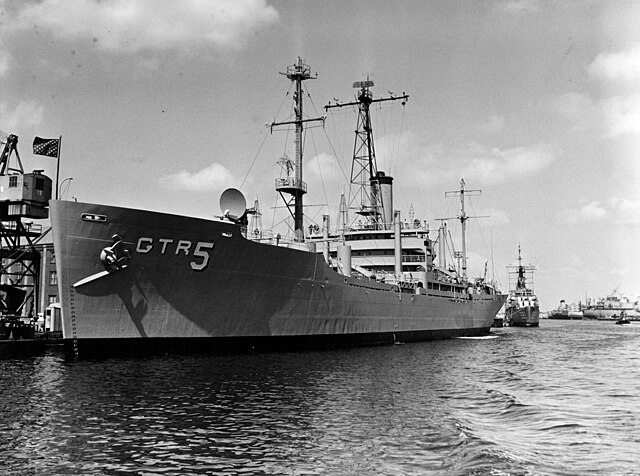
The U.S.S. Liberty incident is back in the national conversation again—and with it, the claim that Israel deliberately attacked an American ship.
On June 8, 1967, during the Six-Day War, the U.S.S. Liberty, an American intelligence vessel, was operating in international waters north of the Sinai Peninsula. Israeli forces, acting on faulty reports, misidentified the ship as hostile and launched an attack using gunfire, rockets, napalm, and torpedoes. Thirty-four American crew members were killed and roughly 170 were wounded.
It was a devastating mistake. But it was a mistake.
Once Israeli commanders realized the ship was American, the attack was halted immediately. Israel issued a formal apology, offered assistance, and paid compensation to the victims and for the damage.
That should have settled the matter. Instead, nearly 60 years later, the incident is still being repackaged as something more sinister—largely by compulsive Israel critics and notable antisemites like Candace Owens. The claim resurfaced in a March 2026 podcast interview with Shawn Ryan, where author Michael Lester repeated it and used it to pivot into a broader allegation: that Israel exerts undue control over the United States.
The accusation is serious, but it lacks evidence.
Take Phil Tourney, president of the USS Liberty Veterans Association and one of the most vocal proponents of the deliberate-attack theory. In an April 2025 debate with journalist Cam Higby, Tourney was pressed on a basic question the narrative can’t answer: motive. Why would Israel deliberately attack an American ship?
In Tourney’s telling, it was part of a sweeping conspiracy between Israel and then–U.S. President Lyndon B. Johnson—a plot to strike the ship, kill American sailors, blame Egypt, and drag the United States into a broader war, even World War III.
But that theory collapses on contact with the facts. Israel never attempted to blame Egypt. More importantly, by the time of the attack, Egypt’s air force had already been destroyed, and its military position had effectively collapsed during the Six-Day War. The incident occurred just hours before Egypt agreed to a ceasefire. There was no strategic logic to provoking a superpower into war against an already defeated adversary—let alone by claiming that Egyptian aircraft carried out the attack when Egypt, at that point, had no air force left to fly.
The inconsistencies didn’t stop there. In earlier accounts, Tourney described two Israeli planes attacking the ship. In the debate, that number became thirty—an extraordinary claim suggesting that Israel deployed most of its air force to destroy a single vessel that, notably, still did not sink. The timeline shifted as well: the attack was said to last 90 minutes, then two hours, despite operational evidence and other testimony indicating a far shorter, chaotic engagement—closer to minutes than hours.
Tourney and other LVA members have also claimed that Israel used unmarked aircraft in the attack to make it appear Egyptian—only to then send in torpedo boats clearly bearing Israel’s Star of David, making their identity unmistakable. The contradiction is hard to miss. If the goal were to frame Egypt, why abandon that effort mid-attack by deploying vessels that openly identified themselves as Israeli? The theory requires both a carefully staged deception and an immediate, inexplicable decision to blow it.
Claims of a sweeping cover-up also begin to unravel under scrutiny. Tourney and others have alleged that survivors were threatened with imprisonment or worse if they spoke out. Yet Liberty crew members began giving interviews within days of the incident. They have written books, produced films, held public events, and continue to speak openly about their views nearly six decades later. Whatever else one might call that, it is not silence.
There have also been documented instances of selective evidence. The LVA has been criticized for removing portions of testimony from the U.S. Naval Court of Inquiry from its materials—particularly accounts indicating that the Liberty may have returned fire, which contradicts claims that the ship was entirely defenseless throughout the attack.
Equally misleading is the assertion that the U.S. government never seriously investigated the incident. In reality, the attack triggered a cascade of inquiries: the Naval Court of Inquiry within two days, followed by investigations by the CIA, the Joint Chiefs of Staff, and an independent review led by Clark Clifford. Congressional committees examined the incident in 1967, 1968, and 1971. Later reviews—including those by the Senate Select Committee on Intelligence in 1979 and the National Security Agency in 1981—revisited the claims in response to new allegations. The conclusion, across all of them, remained the same: no evidence of a deliberate attack.
Declassified NSA intercepts further reinforce that finding. Israeli pilots can be heard expressing confusion about the ship’s identity, believing they were targeting an Egyptian vessel. Once the error was recognized, the attack was called off.
And then there is the broader claim—the one that gives the Liberty narrative its staying power—that this single incident should somehow redefine the entire U.S.-Israel relationship.
That argument is hard to take seriously.
Friendly-fire and misidentification incidents, while tragic, are a recurring feature of warfare—even among close allies. During the Gulf War, U.S. forces mistakenly killed British troops despite clear allied coordination. More recently, in March 2026, Kuwaiti air defenses mistakenly shot down U.S. aircraft during combat operations against Iran. No one suggests these incidents prove hostility between allies or should define those relationships for generations.
Yet when it comes to Israel, a single, thoroughly investigated, 60-year-old battlefield error is repeatedly held up as definitive proof of malice.
That asymmetry is the point. The Liberty incident persists not because new facts have emerged, but because it serves a purpose: it provides a veneer of historical grievance that can be used to portray Israel as uniquely untrustworthy or hostile.
None of this diminishes the loss. Thirty-four Americans were killed in an attack that should never have happened. But tragedy does not transform error into intent, and repetition does not turn speculation into fact.
The historical record has been examined, reexamined, and stress-tested for nearly six decades. The conclusion has held.
Sources
Liberty Incident, Office of the Historian, US Navy, CIA report, Clifford Report, Naval Court of Inquiry, CIA, Joint Chiefs of Staff, US Senate, Clifford Report, House Armed Services Committee, NSNSA, Shawn Ryan, Cam Higby, New York Times, U.S. Central Command