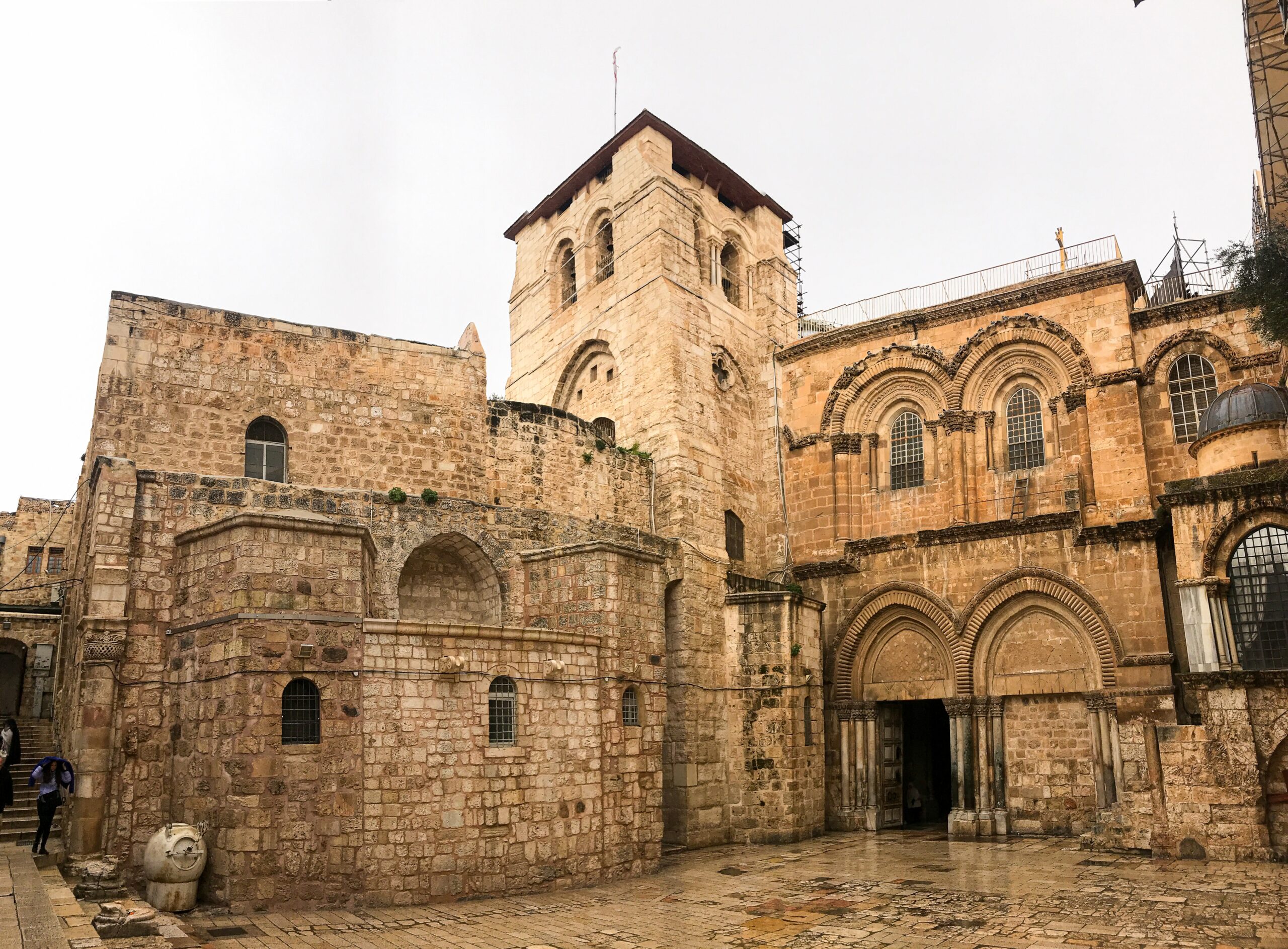
Viral social media posts claim that Israel has “closed the Church of the Holy Sepulchre indefinitely for the first time in Christian history”—while allowing Jews to gather freely.
“Israel has closed the Church of the Holy Sepulchre indefinitely for the first time in the history of Christianity,” wrote one user. “A church that should be packed with hundreds of thousands these coming weeks is being forcibly shut and silenced…Israel cites it is for ‘security concerns’ while Jewish Israelis are allowed to celebrate in mass gatherings.”
That framing falls apart pretty quickly.
Yes, Israeli authorities restricted access to the Church of the Holy Sepulchre after the war with Iran began on February 28, 2026. But they didn’t single out Christians. Similar restrictions were applied to the Al-Aqsa Mosque and the Western Wall.
And yes, the closures were due to “security concerns” that turned out to be well-founded. On Feb. 28, the first day of the war, an Iranian warhead impacted “just a few hundred meters” from Jerusalem’s Old City, where the Church of the Holy Sepulchre is located. The bomb was neutralized by bomb disposal teams of the Israel Police.
Then, on March 16, fragments from intercepted Iranian ballistic missiles fell in several parts of Jerusalem, including near the church. The International Christian Embassy Jerusalem condemned Iran’s missile and drone attacks on civilian areas, noting damage to religious sites.
Had Israel kept the church open, it would almost certainly be accused of failing to protect Christians while supposedly taking stricter precautions for Jews.
The “Mass Gatherings” Claim
The claim that Jews are “allowed to mass gather” is also inaccurate. Israel initially banned gatherings altogether nationwide. Synagogues were closed along with churches and mosques. Authorities then began allowing small groups of up to 50 people to gather only where shelters were nearby. Even during the Jewish holiday of Purim, celebrations were restricted. When Jewish revelers gathered to celebrate in Jerusalem, Israeli police dispersed them with pressure washers.
The “First Time in History” Myth
The “first time in history” claim is also wrong. The church was closed in 2020 during COVID-19, in 2018 during a dispute with Israeli authorities, and for a longer period during the Black Death in 1349. It was also temporarily shut after Saladin captured Jerusalem in 1187. Going further back, it was destroyed in 1009 by al-Hakim bi-Amr Allah and again heavily damaged in 614 during the Persian invasion under Khosrow II.
So no—this isn’t unprecedented, and it isn’t targeted.
Takeaway
What is predictable is the reaction. There’s a real desperation in some circles to paint Israel as anti-Christian, even if it requires flat-out falsehoods. That means claiming discrimination where none exists, ignoring that all major religious sites faced the same restrictions, and pretending missile fire isn’t relevant. The standard is impossible by design: if Israel closes a church, it’s accused of bias; if it leaves it open and people are hurt, it’s accused of negligence. The conclusion is fixed in advance. The facts are just twisted to match it.
Sources
X, Israel Foreign Ministry, Times of Israel, JNS, Times of Israel, Jerusalem Post, Jewish Breaking News, Grokipedia, National Catholic Register, Jerusalem Patriarchate