JERUSALEM — Four Israeli passengers stormed the cockpit of Flydubai Flight 1073 on Wednesday and subdued an Omani co-pilot who, Israeli officials say, attacked the captain with an axe and tried to crash the plane. The jet was carrying 174 passengers, most of them Israeli, including 27 children.
“The incident on the flydubai plane was an attempted jihadist attack, which was only foiled thanks to the heroism of a number of Israeli passengers,” Defense Minister Israel Katz said. “According to the initial information we have, the terrorist had one intention: to crash the plane.”
The Boeing 737 MAX 8 left Dubai for Tel Aviv on the morning of Sept. 30. About 90 minutes into the flight, as it entered Jordanian airspace, the aircraft sent a general-emergency signal. It then switched its transponder to 7500, the international code for unlawful interference. The plane dropped more than 17,000 feet, turned back over northwestern Saudi Arabia, and made an emergency landing in Tabuk.
According to a preliminary investigation, the co-pilot attacked Capt. Smit Machchhar, an Indian instructor captain, with an emergency axe kept in the cockpit for breaking windows. Investigators have ruled out an early theory that he smuggled the axe aboard, since all aircrew undergo strict security screening before boarding. The co-pilot had worked for Flydubai for about nine months.
Badly wounded, Machchhar managed to open the cockpit door. Four Israeli passengers rushed in and overpowered the attacker: Zvika Mans, Yaniv Hayun, Asaf Rejuan and Shota Musayev. An Israeli dentist on board treated the captain and is credited with saving his life. Two other pilots on the flight stabilized the aircraft and landed it.
Prime Minister Benjamin Netanyahu praised the wounded captain. “Despite being stabbed and seriously injured, he fought back, resisted, opened the cockpit door and enabled passengers and crew to overpower the attacker, preventing a catastrophic midair disaster,” he said.
Israel prepared for the worst
The incident set off one of the most intense security responses Israel has mounted for a civilian flight. The Israeli Air Force scrambled fighter jets, Israeli airspace was temporarily closed, and Netanyahu convened his security chiefs. IDF Chief of Staff Lt. Gen. Eyal Zamir canceled a planned trip to Washington.
Before officials knew the situation on board was under control, the military prepared for several disaster scenarios. Fighter jets were sent toward Jordan, ready if necessary to shoot the plane down and prevent a 9/11-style attack. The Air Force’s elite Shaldag unit and the Yamam national counterterrorism unit were put on standby. An Israeli official said the attacker had planned to crash in Israel and was “looking for a symbol,” but would have been intercepted before reaching it.
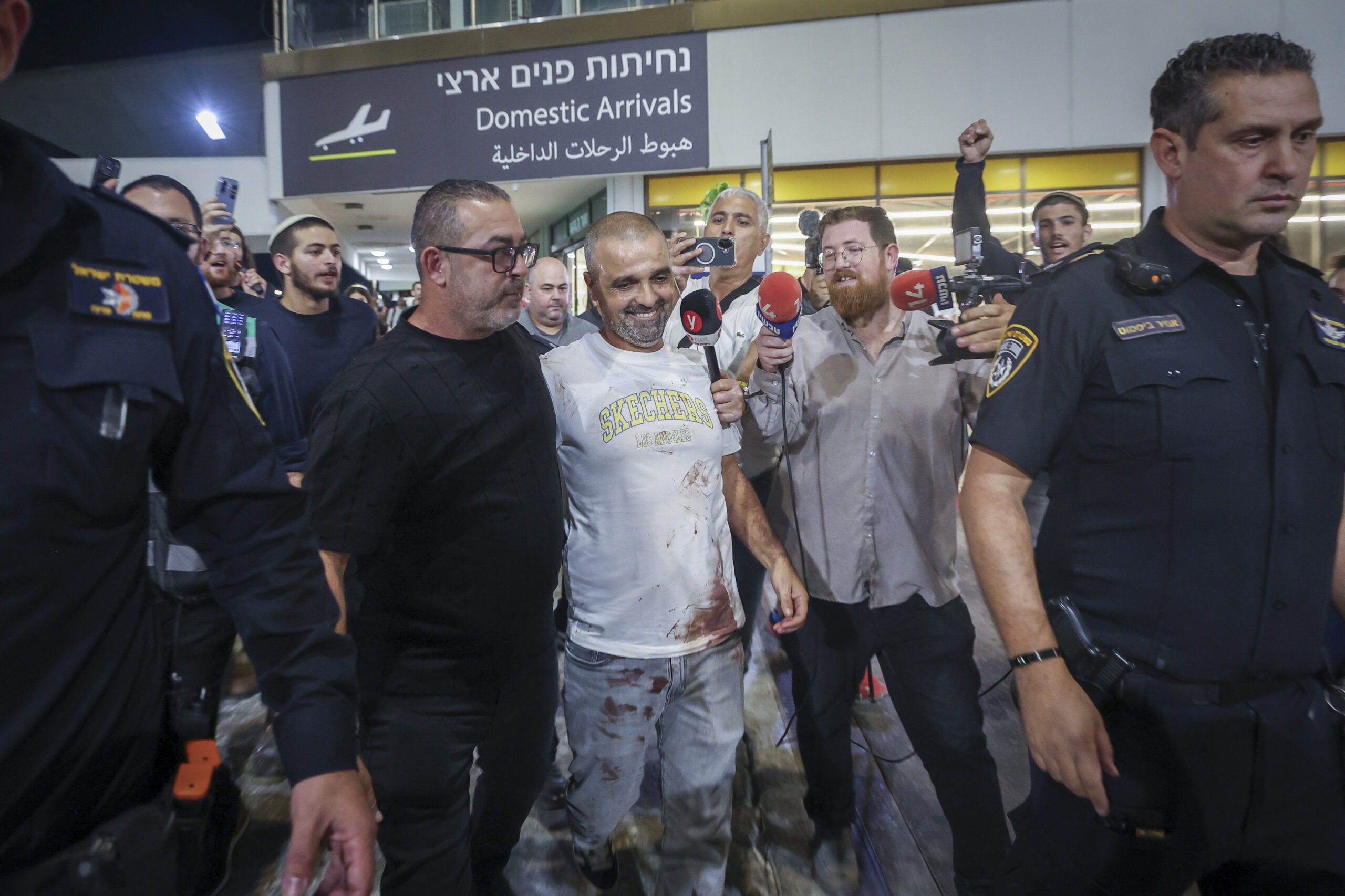
Israeli officials credit the four passengers, the wounded captain and the two pilots who landed the plane with preventing a disaster. The passengers were flown home to Ben Gurion Airport that evening.
Questions over the co-pilot’s clearance
The attack has raised questions about how the co-pilot came to be flying an Israel route. Flydubai’s agreement with Israel requires pilots on flights to Israel to come from countries that have normalized relations with Israel. Oman has no such relations.
The Mossad is leading the investigation and is in contact with its counterparts in Saudi Arabia. Israeli officials expect full cooperation. The Shin Bet is also involved and is expected to question the passengers, particularly the four who subdued the attacker.
“An attack on the Abraham Accords”
Israel’s Foreign Ministry framed the incident as an assault on the country’s ties with the Gulf. Director General Eden Bar Tal briefed Israeli ambassadors and heads of mission around the world, telling them it was “an attempted terrorist attack against Israelis, the United Arab Emirates, and the Abraham Accords.” Within hours, Netanyahu and Foreign Minister Gideon Sa’ar spoke with their Emirati counterparts and pledged cooperation.
Media framing draws criticism
Even as Israeli officials described an attempt to crash the plane, several major news outlets described the incident as a dispute between crew members. Hours after Israeli officials said the attacker had tried to bring the plane down, The New York Times reported that “a violent altercation broke out inside the cockpit.” BBC World ran the headline “Israel-bound flight diverted after fight between pilots.” Al Jazeera was still describing an “altercation” in the cockpit that night.
Flydubai’s own statement also referred to an “altercation” on the flight deck.
For the Israelis aboard Flight 1073, the facts left little room for that description. One man attacked the captain with an axe, and the plane plunged toward the ground until passengers forced their way into the cockpit and stopped him.
Sources
https://www.ynetnews.com/article/s1lpsm95ge
https://www.ynetnews.com/article/rypgvxiqze
https://www.jpost.com/international/article-910155
https://www.jpost.com/israel-news/article-910217
https://www.jpost.com/israel-news/defense-news/article-910192
https://www.timesofisrael.com/liveblog_entry/foreign-ministry-tells-its-diplomats-that-flydubai-attempted-hijacking-was-attack-on-abraham-accords
https://www.timesofisrael.com/netanyahu-saar-speak-to-emirati-counterparts-vow-cooperation-after-flydubai-attack/
https://eng.pressbee.net/show4904091.html