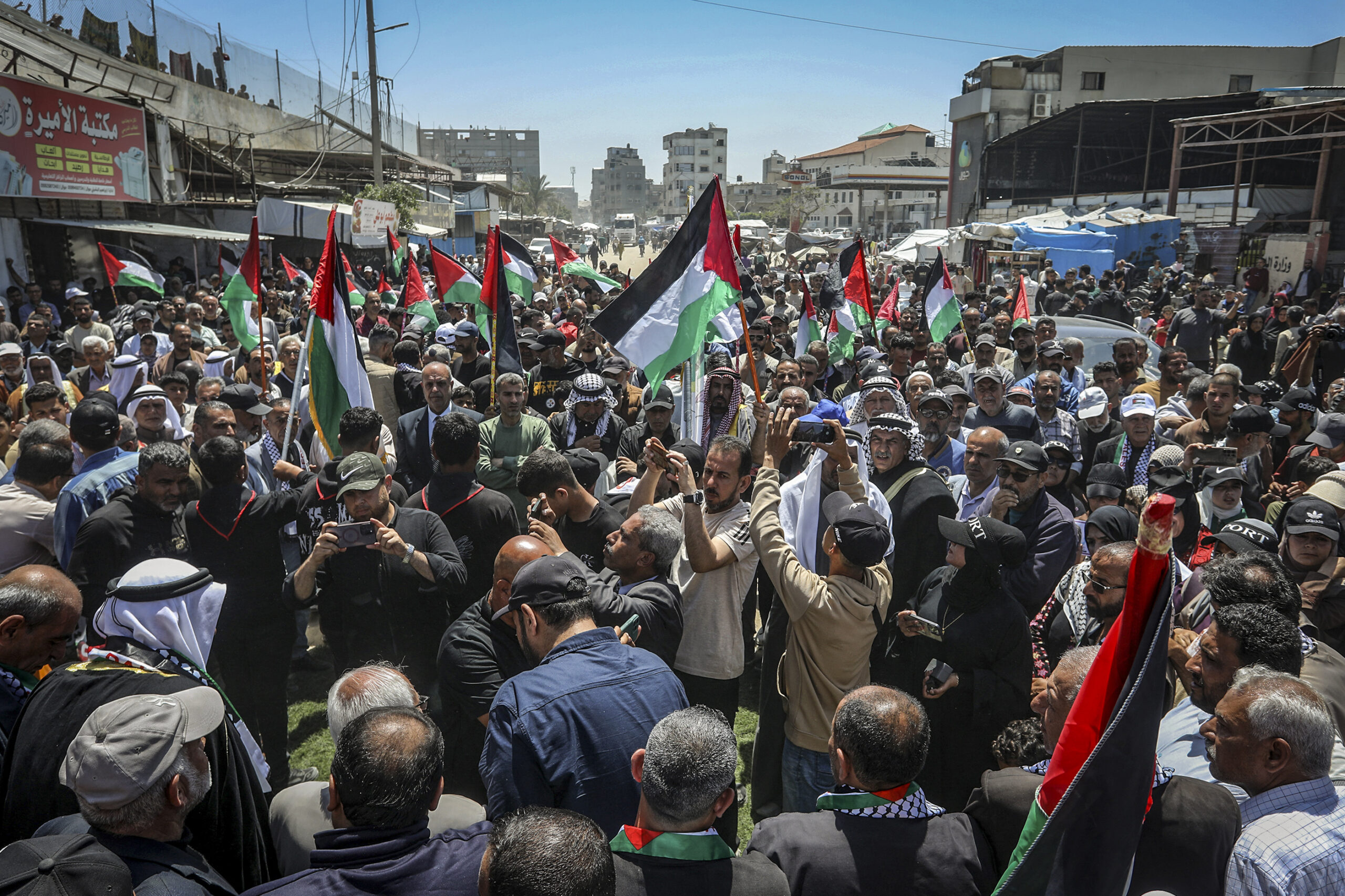
On May 16, 2026, New York City Mayor Zohran Mamdani officially commemorated “Nakba Day” on social media.
“Today marks Nakba Day, an annual day of remembrance to commemorate the expulsion of more than 700,000 Palestinians between 1947 and 1949 during the creation of the State of Israel and the year that followed,” he wrote on X.
To drive the point home, he attached a video of a so-called “Nakba survivor” named Inea Bushnaq, who gave a dramatic account of her alleged expulsion from Palestine.
“Nakba” means catastrophe in Arabic, and according to the pro-Palestinian narrative, the catastrophe was this: in 1948, Zionist forces systematically and deliberately expelled over 700,000 innocent Arabs from their homes to create a Jewish majority state — an act of premeditated ethnic cleansing that Palestinians call the original sin of Israel’s founding.
It’s a false narrative that collapses easily under the weight of the actual historical record.
Let’s start with the name itself. The term wasn’t coined to mourn displaced Arabs. Syrian intellectual Constantin Zurayq coined it in 1948 to lament the catastrophe of Arab armies failing to destroy Israel. The very word is built on a lie.
Who Is Inea Bushnaq?
Bushnaq, often cited as a “Palestinian historian,” is a British citizen whose family left their home in Tulkarm — a city in Samaria that remained under Jordanian control until 1967. Which means her family was never expelled by Israel. They couldn’t have been, because Israel never controlled Tulkarm until nearly two decades after the War of Independence in 1948. The mayor’s hand-picked poster child for “surviving” the Nakba never experienced it.
The War Arabs Started
In 1947, the UN offered a reasonable partition plan (Resolution 181): a Jewish state and an Arab state, side by side. Jews — just 32% of the population — accepted it, even though their territory was fragmented and far from ideal. Arabs, representing 68% of the population, rejected it outright and immediately increased their attacks on Jews..
Israel declared independence on May 14, 1948. Five Arab armies invaded the next day, with the stated goal of exterminating the Jewish state.
Why Arabs Actually Left
The reason most Arabs fled was not because they were expelled by Jewish forces but because Arab leaders told them to.
In Haifa, Israeli Mayor Shabtai Levy — in tears — personally begged Arab community leaders to tell their people to stay, promising their safety. The Zionists wanted Arabs to remain, understanding it would prove their new state could treat minorities fairly. The Arab leaders refused. They had orders from the Arab Higher Committee to leave. Major General Hugh Stockwell, the British military commander of Haifa, told the Arab leaders, “You have made a foolish decision.”
In Jaffa, historian Efraim Karsh — using British military archives — documents the same pattern. Israelis promised safety to Arabs who laid down their arms. Grand Mufti Haj Amin al-Husseini forbade it. Why? Because Arabs staying would lend legitimacy to the Jewish state. He preferred their suffering to Israel’s survival.
The Arab leadership’s own words damn them:
- Azzam Pasha, Secretary-General of the Arab League, advised Palestinians to leave temporarily so Arab armies could sweep through unimpeded in their promised “war of annihilation.”
- King Abdullah of Jordan blamed Palestinian leadership directly in his memoirs, accusing them of paralyzing their own people with false promises of swift victory.
- Iraqi Prime Minister Nuri al-Said told Arabs to clear out while his artillery “smashed” Jewish positions.
Even some Palestinian historians concede this. The exodus was, in large part, orchestrated by Arab leaders who gambled their own people’s homes on a war they lost.
The Numbers Tell the Real Story
First, there is a glaring anachronism at the heart of the entire story: in 1948, there was no such thing as a “Palestinian” people. Arabs in the region identified themselves by tribe, clan, religion, village, or as part of the broader Arab nation. The concept of a distinct Palestinian national identity was invented by the Soviet Union in the 1960s as part of Operation SIG in an attempt to weaken American influence in the region.
Israel could not have expelled “Palestinians” in 1948 because there were none. The ethnic cleansing narrative depends on projecting a modern identity backwards onto history.
The “Nakba” narrative claims Israel ethnically cleansed Palestine. But consider this: 700,000 Arabs fled — out of a population of roughly 1.3 million in British Mandatory Palestine. If Israel intended to expel all Arabs, it failed spectacularly. The truth is simpler: there was no such intention.
And two-thirds of those who fled didn’t even leave the country. They moved from one part of Mandatory Palestine to another — to Jordanian-controlled Judea and Samaria or Egyptian-controlled Gaza. Under any standard definition, a refugee flees their country. Most of these people didn’t.
Yes, there were expulsions — Lydda and Ramla being the most documented cases — where Arab communities that had taken up arms against Jews were forcibly removed. But scattered incidents in a defensive war are not a systematic ethnic cleansing campaign.
The Story Nobody Tells
While the world fixates on Arab refugees, here’s what gets almost no attention: 850,000 Jews were expelled from Arab and Muslim countries — Iraq, Egypt, Yemen, Libya, and others — through pogroms, asset seizures, and state-sanctioned persecution, all triggered by the 1948 war.
Israel absorbed them. They received no UN agency like UNRWA dedicated to their cause in perpetuity, no internationally recognized “right of return,” no endlessly inherited refugee status passed to their grandchildren. Arab states simply kept their property.
If one of these population displacements resembles ethnic cleansing, it’s that one.
Takeaway
The false “Nakba” narrative is a political weapon built on selective memory, Arab leadership’s betrayal of its own people, and the deliberate erasure of Jewish suffering. The real catastrophe of 1948 was that Arab leaders chose war over peace, and their own people paid the price.
Mamdani knows this. He deliberately pushes a narrative that denies Israel’s right to exist, sanitizes the Arab leadership’s role in its own people’s suffering, and spits in the face of the hundreds of thousands of Jewish New Yorkers whose families survived the very war being distorted.
Sources
Mayor Zohran Kwame Mamdani, X, X, U.S. State Department, Honest Reporting, City Journal, Grokipedia, Jewish Virtual Library, Jewish Virtual Library, Britannica, World Jewish Congress